
Math & Science (Period 5 & 6) Assignments
- Instructor
- Mr. Joseph Quinn
- Term
- Second Semester 2015-2016
- Description
-
Upcoming Assignments

No upcoming assignments.
Past Assignments
Due:
Assignment
***Monday, May 2nd, 2016***
Science
• 1) explain how stress in the crust changes Earth’s surface
• 2) describe where faults are usually found and why they form
• 3) identify the land features that result from plate movement
Due:
Assignment
***Friday, April 29th, 2016***
Science
• 1) explain how stress in the crust changes Earth’s surface
• 2) describe where faults are usually found and why they form
• 3) identify the land features that result from plate movement
Due:
Assignment
***Thursday, April 28th, 2016***
Science
• 1) explain how stress in the crust changes Earth’s surface
• 2) describe where faults are usually found and why they form
• 3) identify the land features that result from plate movement
Due:
Assignment
***Monday 25th to Wednesday 27th, 2016***
Due:
Assignment
***Friday, April 22nd, 2016***
Science
• 1) explain how stress in the crust changes Earth’s surface
• 2) describe where faults are usually found and why they form
• 3) identify the land features that result from plate movement
Due:
Assignment
***Thursday, April 21st, 2016***
Science
• 1) explain how stress in the crust changes Earth’s surface
• 2) describe where faults are usually found and why they form
• 3) identify the land features that result from plate movement
Due:
Assignment
***Wednesday, April 20th, 2016***
Science
• 1) explain how stress in the crust changes Earth’s surface
• 2) describe where faults are usually found and why they form
• 3) identify the land features that result from plate movement
Due:
Assignment
***Tuesday, April 19th, 2016***
Science
• 1) explain how stress in the crust changes Earth’s surface
• 2) describe where faults are usually found and why they form
• 3) identify the land features that result from plate movement
Due:
Assignment
***Monday, April 18th, 2016***
Science
• 1) explain how stress in the crust changes Earth’s surface
• 2) describe where faults are usually found and why they form
• 3) identify the land features that result from plate movement
Due:
Assignment
***Friday, April 15th, 2016***
Science
• 1) explain how stress in the crust changes Earth’s surface
• 2) describe where faults are usually found and why they form
• 3) identify the land features that result from plate movement
Due:
Assignment
***Thursday, April 14th, 2016***
Science
• 1) explain how stress in the crust changes Earth’s surface
• 2) describe where faults are usually found and why they form
• 3) identify the land features that result from plate movement
Due:
Assignment
***Wednesday, April 13th, 2016***
Science
• 1) explain how stress in the crust changes Earth’s surface
• 2) describe where faults are usually found and why they form
• 3) identify the land features that result from plate movement
Due:
Assignment
***Tuesday, April 12th, 2016***
Science
• 1) explain how stress in the crust changes Earth’s surface
• 2) describe where faults are usually found and why they form
• 3) identify the land features that result from plate movement
Due:
Assignment
***Monday, April 11th, 2016***
Science
1) stress-
2) tension-
3) compression-
Due:
Assignment
***Friday, April 8th, 2016***
Due:
Assignment
**Thursday, April 7th, 2016**
Science
Due:
Assignment
**Wednesday, April 6th, 2016**
Due:
Assignment
**Tuesday, April 5th, 2016**
Due:
Assignment
**Monday, April 4th, 2016**
***Science***
Due:
Assignment
Thursday, March 24th, 2016
HW: none
Science
Due:
Assignment
Wednesday, March 23rd, 2016
HW: none
Science
Due:
Assignment
Tuesday, March 22nd, 2016
Lesson HW: Answers
HW: Using Unit Prices #2
Science
Due:
Assignment
Monday, March 21st, 2016
Lesson HW: Answers
CW: Using Unit Prices (*Pg 1)
Due:
Assignment
Friday, March 18th, 2016
Lesson HW: Answers
Lesson 7.1.3
- 7-24. MAXIMUM MILES
- See answers in bold in table below.
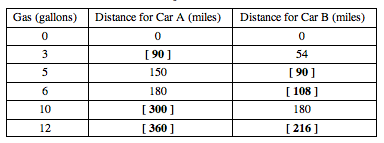
- Car A travels the farthest, 150 miles, and car B travels only 90 miles.
- See sample table below.
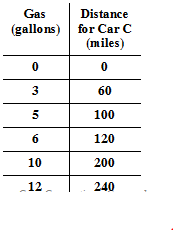
- See answers in bold in table below.
- 7-25. See below:
- Car A (30 miles per 1 gallon), Car C (20 miles per 1 gallon), Car B (18 miles per 1 gallon). See Suggested Lesson Activity for possible student responses.
- See graph below.
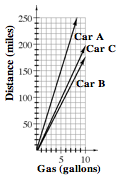
- The steeper the line, the more miles traveled per gallon. Therefore, the car with the best gas mileage is the one that is steepest on this graph. Car A, Car C, Car B. Car A goes farthest.
- 7-26. See below:
- Answers are in bold in the table.
TamikaLoisTime
(in hours)Length
(in inches)Time
(in hours)Length
(in inches)0 5 0 0 1 7 1 3 2 9 2 6 3 11 3 9 - 2 inches per hour. It is the amount the length changes from one row in the table to the next and the hours go up by one each time.
- 3 inches per hour. It is the amount the length changes from the first row with 0 inches to the second row with one hour and 3 inches.
- It will take her 9 hours total (or 6 more hours from now).
- Tamika’s scarf will be 29 inches; one possible method is to multiply 2 inches per hour times 12 hours and add 5 inches the amount that she already had done. Lois’ scarf would be 36 inches; one possible method is to multiply 3 inches per hour by 12 hours.
- Lois’ line would be steeper. She is knitting at a faster rate.
- Answers are in bold in the table.
- 7-27. See below:
- She knits 45 inches over the course of 10 hours, so she knits 4.5 inches per hour.
- 62 inches. This is much more than Tamika or Lois.
- 7-28. See below:
- It will make 15 revolutions per minute.

- 7-30. See below:
- DWest, because it has a unit rate of $0.15/min.
- 7-31. See below:
- C
- $4 per pound
- Store A. Its line is steepest.
- 7-32. See below:
- P = 41cm, A = 79.1 sq cm
- P = 60 in., A = 150 sq. in.
- 7-33. See below:
-
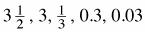
- 7-34. See below:


Science
Due:
Assignment
Thursday, March 17th, 2016
Lesson HW: Answers
Lesson 7.1.2
- 7-14. See below:
- Answers are given in table below; Wendy is running 30 meters every 5 seconds. 30 meters:5 seconds.
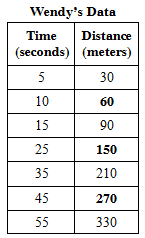
- No. Yoshie is running faster. Possible response: Yoshie can go 210 meters in 33 seconds, Wendy goes 210 in 35 seconds.
- Answers are given in table below; Wendy is running 30 meters every 5 seconds. 30 meters:5 seconds.
- 7-15. See below:
- See possible tabe below.

- See answer graph below.
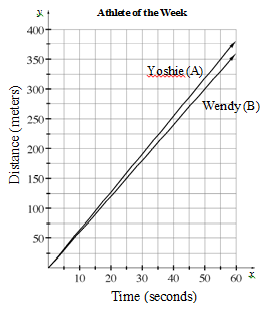
- Yoshie is running faster because her line covers more meters per second or because it is steeper. Yes this matches previous conclusion.
- Vanessa would be the slowest of the three girls as she runs 5 meters every second. Yoshie would win.
- See possible tabe below.
- 7-16. See below:
- Segment b (the bicycle portion), because it is steepest.
- Event a is 0.5 miles, Event b is 12 miles, Event c is 3 miles.
- Event a took 18 minutes, Event b spanned 42 minutes, Event c took 33 minutes.
- Answers should be equivalent to:
 for Event a,
  for Event b,
  for Event c
- 7-17. See below:
- It makes sense to connect because the data is continuous. At zero minutes, Edgar will have traveled 0 miles. See sample graph below.
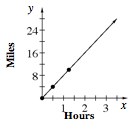
- She runs faster than Edgar. Possible response: She runs 8.5 miles in one hour and Edgar runs 8 miles.
- It makes sense to connect because the data is continuous. At zero minutes, Edgar will have traveled 0 miles. See sample graph below.
- 7-18. See below:

- 7-19. See below:
- See sample graph below.
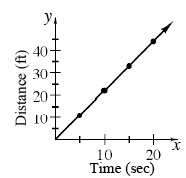

- Steeper, because she is traveling faster at
 .
.
- See sample graph below.
- 7-20. See below:
- The other side is
 inches, perimeter is
  inches.
- The other side is
- 7-21. See below:
- 0.6, 60%, three fifths or six tenths
 , 70%, seven tenths
 , sixteen hundredths
- 245%,
 , two and forty-five hundredths
- 7-22. See below:
- 35
- 3
- 2
- 4
- 7-23. See below:

- 3.936
- 0.548

Due:
Assignment
Wednesday, March 16th, 2016
HW: no homework
Lesson HW: Answers
Due:
Assignment
Tuesday, March 15th, 2016
Lesson 7.1.1 HW: Answers
- 7-9. See below:
- $144 ÷ $36 = 4 sets of 4 hours, 16 hours
 ≈ 6.167 sets of 4 hours,
  hours
hours- $360 for a 40-hour week, $63 for a 7 hour day.
- 7-10. See below:
- 3:2
- 3:5
- 40%

- 7-11. Estimations vary.
 is just over 1, so half of that will be just over
  ;
; 
 and
and  are both a little less than 1, so the product will be less than 1 but more than ;
 is close to but less than , so the product will be close to but less than
 ;
; 
- 7-12. See below:
- 6 inches
- 46 inches
- Kip
- 7-13. See below:
- Two possible answers: P = 46, labeled 22 units by 1 unit or P = 26, labeled 11 units by 2 units
Due:
Assignment
Monday, March 14th, 2016
HW: No homework
Lesson 7.1.1 CW: Answers
- 7-1. Comparing Rates
- $960 because they would work for 3 sets of 2 weeks, and 320 · 3 = 960. $1050 because they can earn $350 in 2 weeks washing cars, so 350 · 3 = 1050 or 700 + 350 = 1050.
- Since
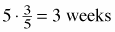 , 85 · 5 = 425 dollars.
- 7-3. See below:
- (500)(10) = 5000 , so (3)(10) = 30 weeks
- Between 28 and 29 weeks; at 28 weeks, they will have earned $4900; at 29 weeks, they will have earned $5075.
- By washing cars, the class will get to $5000 faster.
- 7-4. See below:
- It is a reasonable estimate. $175 · 4 = $700 . Sample reasoning: He could have divided $700 by 2 to find out how much the class would make in two weeks, and then divided that amount by 2 to find out how much they would make in one week.
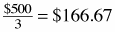 in one week
 - By washing cars, the class makes more money each week.
- 7-5. See below:
- Because both 3 and 4 go evenly into 12.
- $2000 from cookie sales; $2100 from car washes.
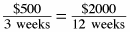 for cookie sales,
 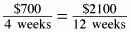 for car washes
- The class makes more in twelve weeks by washing cards, so the class will earn money faster this way.
- 7-6. See below:
- Answers will vary, but should indicate that car washes have the highest profit rate.
Due:
Assignment
Friday, March 11th, 2016
SCIENCE
*describe the process of subduction at deep- ocean trenches
Due: Sea-Floor Drawing
Due:
Assignment
Thursday, March 10th, 2016
Lesson & HW 5.2.3 Answers
- 5-66. RECTANGLE PUZZLE
- See the "Suggested Lesson Activity" for sample arrangements.
- 5-67. See below:
- Figure A = 36 square units, Figure B = 42 square units. No, it does not matter, but students might note that finding the area of the rectangle is easier.
- 5-68. See below:
- The sum of the areas of each smaller part is equal to the area of the larger, composite rectangle. This is true because all of the small parts together form the larger rectangle.
- 5-69. See below:
- Base and height, length and width
- No answer
- Multiple rectangles are possible; rectangles will have bases and heights of different lengths.
- Yes. The size of the space they are working with has not changed, it has just been rearranged.
- 5-71. See below:
- Segments b or c. They each form a 90° angle with the base.
- 5-72. See below:
-
-
See sample diagram below.
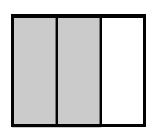
- See sample diagram below.
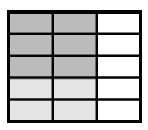
- Multiplication.
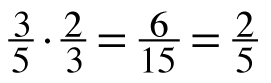
-
- 5-73. See below:
- (1, 1), (1, 2), (2, 1), (2, 2), (2, 3), (3, 1), (3, 2), (4, 3)
- (2, 4) or with (2, 0)
- 5-74. See below:
- 112 whiskers
- 4 eye-stalks
- 40 legs
- 5-75. See below:
- 2700 + 360 + 30 + 4 = 3094
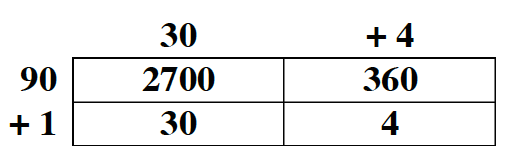
- 12000 + 600 + 2400 + 120 + 30 + 6 = 15,156
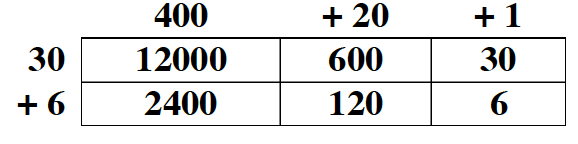
- 2700 + 360 + 30 + 4 = 3094
Due:
Assignment
Wednesday, March 9th, 2016
Standard: 6.NS.1. Interpret and compute quotients of fractions, and solve word problems involving division of fractions by fractions, e.g., by using visual fraction models and equations to represent the problem. For example, create a story context for (2/3) ÷ (3/4) and use a visual fraction model to show the quotient; use the relationship between multiplication and division to explain that (2/3) ÷ (3/4) = 8/9 because 3/4 of 8/9 is 2/3. (In general, (a/b) ÷ (c/d) = ad/bc.) How much chocolate will each person get if 3 people share 1/2 lb of chocolate equally? How many 3/4-cup servings are in 2/3 of a cup of yogurt? How wide is a rectangular strip of land with length 3/4 mi and area 1/2 square mi?
HW: No Homework
SCIENCE
*describe the process of subduction at deep- ocean trenches
2) What device is used to map the ocean floor?
#6 Sea-Floor Spreading Applying Concepts (A)
Q) What happens to the rock along the ridge when new molten material erupts?
CW: “Sea Floor Spreading” Drawing.
****DUE FRIDAY****
Due:
Assignment
Tuesday, March 8th, 2016
Standard: 6.NS.1. Interpret and compute quotients of fractions, and solve word problems involving division of fractions by fractions, e.g., by using visual fraction models and equations to represent the problem. For example, create a story context for (2/3) ÷ (3/4) and use a visual fraction model to show the quotient; use the relationship between multiplication and division to explain that (2/3) ÷ (3/4) = 8/9 because 3/4 of 8/9 is 2/3. (In general, (a/b) ÷ (c/d) = ad/bc.) How much chocolate will each person get if 3 people share 1/2 lb of chocolate equally? How many 3/4-cup servings are in 2/3 of a cup of yogurt? How wide is a rectangular strip of land with length 3/4 mi and area 1/2 square mi?
HW: CPM Booklet: Chapter 5.2.2 Preview & Review 5-53 through 5-56
Lesson & HW 5.2.2 Answers
- 5-53. HOW MANY TIMES?
- The club has less money to spend than Shane had planned since
 is less than 1.
- The club has less money to spend than Shane had planned since
- 5-54. See below:
- 2.5
- 2
- 1

- 1


- 5-55. See below:
- 2 will enlarge the most. will reduce the most. 1 will have the least effect.
- Multiplying by a number closer to one has less of an effect than multiplying by a number farther from one. Multiplying by a number between 0 and 1 reduces the size of the photo.
- 2
- 5-56. See below:


- 5-57. See below:
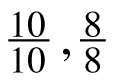
- The three methods are equivalent and they will all work.
- 5-58. See below:
-
- 5-59. See below:
- 2.5, 2,
 , 250%
 - 2,
 , 200%
 - 1.5, 1,
 , 150%
 - 1,
 , 100%
 - ,
 ,
, 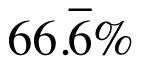
- , 0.5, 50%
- ,
 ,
, 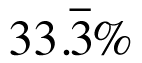
- , 0.2, 20%
- 2.5, 2

- 5-61. See below:
-
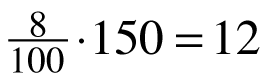
- 0.085 · 70 = 5.95
-
- 5-62. See below:
-
She should multiply each length measurement by a fraction close to zero.
- She should multiply each length measurement by a number slightly larger than 1.
-
- 5-63. See below:
- They ran the same distance, as of
 is
is  , and of is .
- They ran the same distance, as
- 5-64. See below:
-
1

- 2

-
- 5-65. See below:
- 5 cm
- 8 cm
- 16.4 cm
- 5 cm
Due:
Assignment
Monday, March 7th, 2016
Standard: 6.RP.3c. Find a percent of a quantity as a rate per 100 (e.g., 30% of a quantity means 30/100 times the quantity); solve problems involving finding the whole, given a part and the percent.
HW: CPM Booklet: Chapter 5.2.1 Preview & Review (48 to 52)
Lesson & HW 5.2.1 Answers
-
- 5-39. See below.
- See Suggested Lesson Activity for possible representations. Lorna will pay 18% of the original price.
- 5-40. See below.
- 0.6(0.3) = 0.18
- No; students could reason that 0.4 is less than one half, so the product should be less than half of 0.2, or less than 0.1.
-
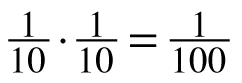 ; 0.1 · 0.1 = 0.01
 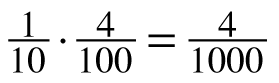 ; 0.1 · 0.04 = 0.004
- 0.08
- Students should notice that for these problems with numbers between 0 and 1, the multiplication always resulted in products smaller than the numbers multiplied.
- 5-41. See below.
- It is the same as 20%
- See diagram below. 0.8624
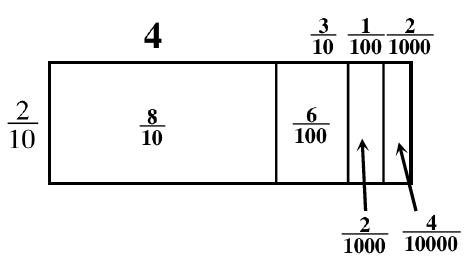
- Each of the subproducts is a part of the generic rectangle written as a decimal rather than a fraction.
- 0.8624
- Ben’s method ensures you are adding digits with the same place value.
- 5-42. See below.

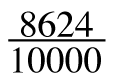 = 0.8624
- 5-43. See below.
- More than 2. Possible reason: the sum of 1.8 and 0.2 would be 2, so adding a number greater than 0.2 to 1.8 yields a result greater than 2.
- The product of 6 tenths and 9 tenths is 54 hundredths; the product of 6 tenths and 3 is 18 tenths, or 1 whole and 8 tenths; Yes, he is correct.
- Mohamed could write 13 tenths as 1 whole and 3 tenths, or 1.3. In other words, he could write a 3 in the tenths place and “carry the one.”
- 2.34
- 5-44. See below.
- 0.00003
- 0.3715
- 2.5256
- 5-45. See below.
- 0.12 or
 mile
mile
- 0.12 or
- 5-46. See below.
- Students might reason that 0.03(0.04) = 0.0012, and 0.0012 is equivalent to 0.12%; students might also observe that 3% of 4% would be a small portion of 4%, so it does not make sense for the product to increase to 12%.

- 5-48. See below.
- $152.60. Possible response: 10% is the same as 0.1, and this is the portion of his salary he needs to calculate, so he can multiply, seeing this as a part (0.1) of an amount.
- 5-49. See below.
- 890 square feet
- 890
- 5-50. See below.
-
0.028
- 0.54
-
- 5-51. See below.
- See possible diagram below.

- 5 feet
- See possible diagram below.
- 5-52. See below.
- 25%, 0.25, one fourth or twenty-five hundredths
- 76%, 0.76, nineteen twenty-fifths or seventy-six hundredths
- 150%, 1.5, three halves or one and one half
- 37.5%, 0.375; three eighths or three hundred seventy-five thousandths
- 5-39. See below.
SCIENCE
*describe the process of subduction at deep- ocean trenches
2) What device is used to map the ocean floor?
Due:
Assignment
Friday, March 4th, 2016
Standard: Prep for: 6.NS.1. Interpret and compute quotients of fractions, and solve word problems involving division of fractions by fractions, e.g., by using visual fraction models and equations to represent the problem. For example, create a story context for (2/3) ÷ (3/4) and use a visual fraction model to show the quotient; use the relationship between multiplication and division to explain that (2/3) ÷ (3/4) = 8/9 because 3/4 of 8/9 is 2/3. (In general, (a/b) ÷ (c/d) = ad/bc.) How much chocolate will each person get if 3 people share 1/2 lb of chocolate equally? How many 3/4-cup servings are in 2/3 of a cup of yogurt? How wide is a rectangular strip of land with length 3/4 mi and area 1/2 square mi? (dividing fractions)
HW: CPM Booklet: Chapter 5.1.4 Preview & Review (34 to 38)
Lesson & HW 5.1.4 Answers
- 5-29. See below:
- Predictions vary, but should be about 12 miles.
- See diagram below.
 miles
miles
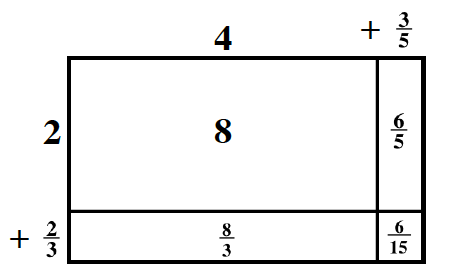
- Answers vary.
- 5-30. See below:
- No answers.
- See generic rectangle below.
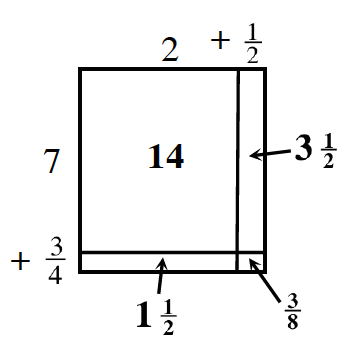
- 14 + 3.5 + 1.5 + 0.375 = 19.375 m2
- 5-31. See below:
- See diagram below,

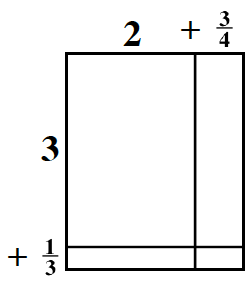
- Possible response: She knows that it is between 6 and 12 because 2 · 3 = 6 and it is more than this but not as much as 3 · 4 = 12, which is what she would get if she rounded both fractions up to the nearest whole number. She could make the mixed numbers into fractions greater than one and multiply.
 cups
cups- Anita would convert the fraction greater than one that she gets as a product to a mixed number.
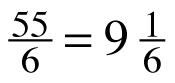
- See diagram below,
- 5-32. See below:
- 6. No.
- Answers vary; students may draw a generic rectangle and explain that Jessica’s method leaves out two portions of the total area.
- 6
- 5-33. See below:
-

- 8.04
- 1

-
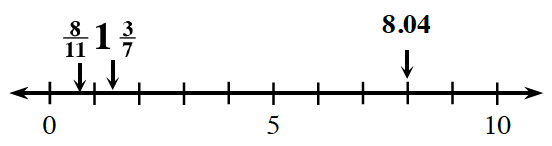
- 5-34. See below:
-

- 5-35. See below:
- Answers will vary.
- 5-36. See below:
- See number line below.
-
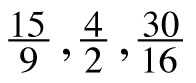 and
and 
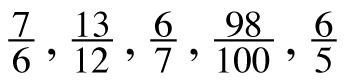
 and
and 
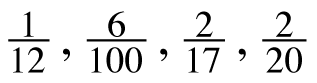
-

- 5-37. See below:
- Answers will vary, but students should explain that the 8 in each number must be placed according to the number of tenths, hundredths, etc., he needs.8% = 0.08, 80% = 0.8, and 800% = 8.
- 5-38. See below:
- 7.5
- 0.75
- 0.075
- Sample response: The decimal point moves to the left.
SCIENCE
*describe the process of subduction at deep- ocean trenches
1) What evidence did scientists find for sea-floor spreading?
Due:
Assignment
Thursday, March 3rd, 2016
Standard: Prep for: 6.NS.1. Interpret and compute quotients of fractions, and solve word problems involving division of fractions by fractions, e.g., by using visual fraction models and equations to represent the problem. For example, create a story context for (2/3) ÷ (3/4) and use a visual fraction model to show the quotient; use the relationship between multiplication and division to explain that (2/3) ÷ (3/4) = 8/9 because 3/4 of 8/9 is 2/3. (In general, (a/b) ÷ (c/d) = ad/bc.) How much chocolate will each person get if 3 people share 1/2 lb of chocolate equally? How many 3/4-cup servings are in 2/3 of a cup of yogurt? How wide is a rectangular strip of land with length 3/4 mi and area 1/2 square mi? (dividing fractions)
HW: CPM Booklet: Chapter 5.1.4 Preview & Review (34 to 38)
Lesson & HW 5.1.4 Answers
- 5-29. See below:
- Predictions vary, but should be about 12 miles.
- See diagram below. miles
- Answers vary.
- 5-30. See below:
- No answers.
- See generic rectangle below.
- 14 + 3.5 + 1.5 + 0.375 = 19.375 m2
- 5-31. See below:
- See diagram below,
- Possible response: She knows that it is between 6 and 12 because 2 · 3 = 6 and it is more than this but not as much as 3 · 4 = 12, which is what she would get if she rounded both fractions up to the nearest whole number. She could make the mixed numbers into fractions greater than one and multiply.
- cups
- Anita would convert the fraction greater than one that she gets as a product to a mixed number.
- See diagram below,
- 5-32. See below:
- 6. No.
- Answers vary; students may draw a generic rectangle and explain that Jessica’s method leaves out two portions of the total area.
- 6
- 5-33. See below:
-
- 8.04
- 1
-
- 5-34. See below:
-
- 5-35. See below:
- Answers will vary.
- 5-36. See below:
- See number line below.
-
and
- and
-
- 5-37. See below:
- Answers will vary, but students should explain that the 8 in each number must be placed according to the number of tenths, hundredths, etc., he needs.8% = 0.08, 80% = 0.8, and 800% = 8.
- 5-38. See below:
- 7.5
- 0.75
- 0.075
- Sample response: The decimal point moves to the left.
Due:
Assignment
Wednesday, March 2nd, 2016
Standard: Prep for: 6.NS.1. Interpret and compute quotients of fractions, and solve word problems involving division of fractions by fractions, e.g., by using visual fraction models and equations to represent the problem. For example, create a story context for (2/3) ÷ (3/4) and use a visual fraction model to show the quotient; use the relationship between multiplication and division to explain that (2/3) ÷ (3/4) = 8/9 because 3/4 of 8/9 is 2/3. (In general, (a/b) ÷ (c/d) = ad/bc.) How much chocolate will each person get if 3 people share 1/2 lb of chocolate equally? How many 3/4-cup servings are in 2/3 of a cup of yogurt? How wide is a rectangular strip of land with length 3/4 mi and area 1/2 square mi? (dividing fractions)
HW: No homework
Due:
Assignment
Tuesday, March 1st, 2016
Due:
Assignment
Monday, February 29th, 2016
Standard: Prep for: 6.NS.1. Interpret and compute quotients of fractions, and solve word problems involving division of fractions by fractions, e.g., by using visual fraction models and equations to represent the problem. For example, create a story context for (2/3) ÷ (3/4) and use a visual fraction model to show the quotient; use the relationship between multiplication and division to explain that (2/3) ÷ (3/4) = 8/9 because 3/4 of 8/9 is 2/3. (In general, (a/b) ÷ (c/d) = ad/bc.) How much chocolate will each person get if 3 people share 1/2 lb of chocolate equally? How many 3/4-cup servings are in 2/3 of a cup of yogurt? How wide is a rectangular strip of land with length 3/4 mi and area 1/2 square mi? (dividing fractions)
HW: No homework
SCIENCE
*describe the process of subduction at deep- ocean trenches
Due:
Assignment
Friday, February 26th, 2016
Standard: Prep for: 6.NS.1. Interpret and compute quotients of fractions, and solve word problems involving division of fractions by fractions, e.g., by using visual fraction models and equations to represent the problem. For example, create a story context for (2/3) ÷ (3/4) and use a visual fraction model to show the quotient; use the relationship between multiplication and division to explain that (2/3) ÷ (3/4) = 8/9 because 3/4 of 8/9 is 2/3. (In general, (a/b) ÷ (c/d) = ad/bc.) How much chocolate will each person get if 3 people share 1/2 lb of chocolate equally? How many 3/4-cup servings are in 2/3 of a cup of yogurt? How wide is a rectangular strip of land with length 3/4 mi and area 1/2 square mi? (dividing fractions)
HW: Have a great weekend.
SCIENCE
*describe the process of subduction at deep- ocean trenches
Due:
Assignment
Thursday, February 25th, 2016
Standard: Prep for: 6.NS.1. Interpret and compute quotients of fractions, and solve word problems involving division of fractions by fractions, e.g., by using visual fraction models and equations to represent the problem. For example, create a story context for (2/3) ÷ (3/4) and use a visual fraction model to show the quotient; use the relationship between multiplication and division to explain that (2/3) ÷ (3/4) = 8/9 because 3/4 of 8/9 is 2/3. (In general, (a/b) ÷ (c/d) = ad/bc.) How much chocolate will each person get if 3 people share 1/2 lb of chocolate equally? How many 3/4-cup servings are in 2/3 of a cup of yogurt? How wide is a rectangular strip of land with length 3/4 mi and area 1/2 square mi? (dividing fractions)
HW: CPM booklet Review & Preview 5.1.3 (24 to 28)
Lesson 5.1.3
ANSWERS
- 5-18. See below:
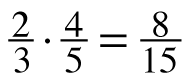 ,
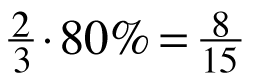
, 
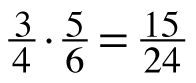
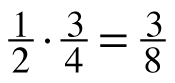
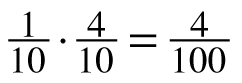
- 5-19. See below:
- Descriptions vary: students may notice that this is pictured in part (a) of problem 5-18; they could also describe drawing a rectangle partitioned into fifths in one direction, with four of them shaded and partitioned into thirds in the other direction with two of those shaded.
- There would be 15 parts. Cutting 5 parts into 3 pieces each yields 5 · 3 = 15 pieces.
- 8 parts. Justifications depend on the model being used; the four shaded fifths are each broken into three pieces, only 2 of which get double shaded, so 2 in each of 4 parts yields 2 · 4 = 8 parts.
- The numerator of the product is the product of the numerators and the denominator of the product is the product of the denominators.
- 5-20. See the “Suggested Lesson Activity” for sample explanations.


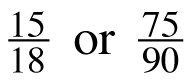
- 5-21. See below:
- Possible response: there are three eighths shaded; if students consider only one third of this, they can see that that would be one eighth; it is not necessary in this case to partition further.
- of is
 , of is
  or
or - Possible answers include:
 ,
, 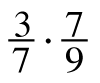 , etc.
- 5-22. See below:
 or
or  or
or  or 46%
 - 2
 or
or 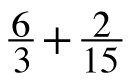
- 5-24. See below:

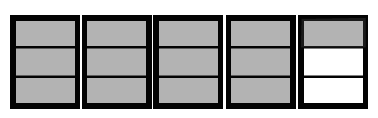
- 3


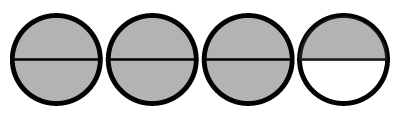
- 1

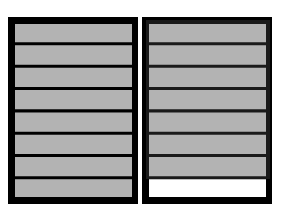
- 5-25. See below:
 or
or 

- 5-26. See below:
- 6800
- 68
- 6800
- The decimal point moves to the right.
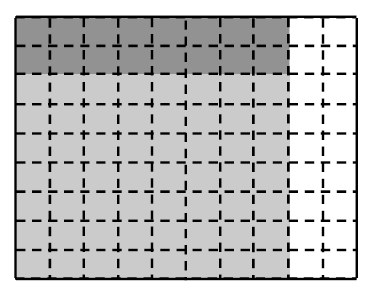
- 5-27. See diagrams below.
-
- 5-28. See below:
- Yes. The new rectangle has a base of 12 cm, height of 3 cm, and area of 36 sq cm, greater than the original rectangle.
- No, her claim is incorrect. Yes, a rectangle can have its perimeter increase while the area stays the same. For example, if Sophie’s rectangle were changed to a 2 cm by 9 cm, the area is the same, but the perimeter increases to 22 cm.
SCIENCE
*describe the process of subduction at deep- ocean trenches
(1) mid-ocean ridge-
(2) sonar-
(3) sea-floor spreading-
(4) deep-ocean trench-
(5) subduction-
Due:
Assignment
Wednesday, February 24th, 2016
Standard: Prep for: 6.NS.1. Interpret and compute quotients of fractions, and solve word problems involving division of fractions by fractions, e.g., by using visual fraction models and equations to represent the problem. For example, create a story context for (2/3) ÷ (3/4) and use a visual fraction model to show the quotient; use the relationship between multiplication and division to explain that (2/3) ÷ (3/4) = 8/9 because 3/4 of 8/9 is 2/3. (In general, (a/b) ÷ (c/d) = ad/bc.) How much chocolate will each person get if 3 people share 1/2 lb of chocolate equally? How many 3/4-cup servings are in 2/3 of a cup of yogurt? How wide is a rectangular strip of land with length 3/4 mi and area 1/2 square mi? (dividing fractions)
HW: CPM booklet Review & Preview 5.1.2 (13 to 17)
Answers to 5.1.2
Lesson 5.1.2
- 5-9. See below:
- Since
 is just a bit over , students may reason that ’s of that will be less than one half.
 - In each diagram, students could partition each of the sevenths into thirds, then double-shade two thirds of each; they could then count to see that 8 of 21 parts are double-shaded, for a result of
 .
. - Answers vary.
- Since
- 5-10. See below:

 or
or 
- 5-11. See below:
- This is equivalent to one eighth.
- This is also equivalent to one eighth.
- Justifications will vary, but students may say that it is the same thing as 2 times 3 being equal to 3 times 2, which is the Commutative Property of Multiplication.
- 5-12. See below:
 of the whole mural, see diagram below.
 , see diagram below.
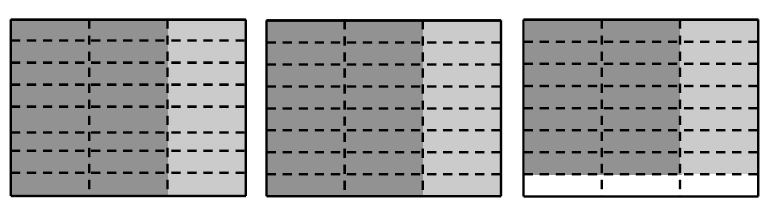
- 5-13. See below:
- 20%, , two tenths
- 5%, 1
 , five hundredths
 - 175%, 1, one and seventy-five hundredths
- 0.2%,
 , or
, or  , two thousandths
- 20%,
- 5-14. Diagrams will vary:

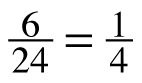
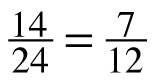

- 5-15. See below:
- 6
- −8
- 28
- 24
- 0
- 4
- 5-16. See below:
- 3n + 10. n = 5 ft
- 3x + 10. x = 100 ft
- 2j + 10. j = 1.5ft
- 5-17. See below:

- 12

- 6

Due:
Assignment
Tuesday, February 23rd, 2016
Standard: Prep for: 6.NS.1. Interpret and compute quotients of fractions, and solve word problems involving division of fractions by fractions, e.g., by using visual fraction models and equations to represent the problem. For example, create a story context for (2/3) ÷ (3/4) and use a visual fraction model to show the quotient; use the relationship between multiplication and division to explain that (2/3) ÷ (3/4) = 8/9 because 3/4 of 8/9 is 2/3. (In general, (a/b) ÷ (c/d) = ad/bc.) How much chocolate will each person get if 3 people share 1/2 lb of chocolate equally? How many 3/4-cup servings are in 2/3 of a cup of yogurt? How wide is a rectangular strip of land with length 3/4 mi and area 1/2 square mi? (dividing fractions)
HW: CPM booklet Review & Preview 5.1.1 (4 to 8)
Lesson 5.1.1_Answers
- 5-1. MURAL MADNESS
- Morgan has completed the most, followed by Riley. Reggie completed the least. Morgan has completed
 or
or  , Riley has completed
  , and Reggie has completed
  or
or  of the space.
- Morgan has completed the most, followed by Riley. Reggie completed the least. Morgan has completed
- 5-2. See below:
- Yes.
- The entire area is 1 square unit. The lightly shaded part represents Riley's assigned portion.
- The darkly shaded part represents how much Riley finished. One sixth, or one sixth of a unit.
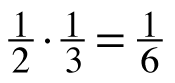 .
.
- 5-3. See below:


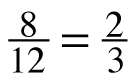

HW: 5.1.1_Answers
- 5-4. See below:
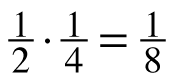
- 5-5. See below:
 or
or - The width would be 2 units and the length would be 1.5 units.
- 5-6. See below:
- 5-7. See below:

- 2

- 22
- 5-8. See below:


- 9

Due:
Assignment
Monday, February 22nd, 2016
Standard: Prep for: 6.NS.1. Interpret and compute quotients of fractions, and solve word problems involving division of fractions by fractions, e.g., by using visual fraction models and equations to represent the problem. For example, create a story context for (2/3) ÷ (3/4) and use a visual fraction model to show the quotient; use the relationship between multiplication and division to explain that (2/3) ÷ (3/4) = 8/9 because 3/4 of 8/9 is 2/3. (In general, (a/b) ÷ (c/d) = ad/bc.) How much chocolate will each person get if 3 people share 1/2 lb of chocolate equally? How many 3/4-cup servings are in 2/3 of a cup of yogurt? How wide is a rectangular strip of land with length 3/4 mi and area 1/2 square mi? (dividing fractions)
HW: Title: "Parts of Parts"
Science
describe the theory of continental drift;
list the evidence used by Alfred Wegener to form his theory and why other scientists rejected it.
CW: #7 Drifting Continents_Inferring (A)
*Q) What do the matching mountain ranges in Africa and South America show, according to Wegener’s hypothesis?
Due:
Assignment
Friday, February 19th, 2016
Number Talk: 16 x 35
HW Check & Review: Rates and Unit Rates
Objective/Purpose: Students will discover unit rates and their usefulness in solving real world problems in context
Standard: 6.RP.3b Solve unit rate problems including those involving unit pricing and constant speed. For example, if it took 7 hours to mow 4 lawns, then at that rate, how many lawns could be mowed in 35 hours? At what rate were lawns being mowed?
NOTE: A UNIT Rate is a SPECIAL rate that compares a quantity of one type to a quantity of a different ONE or "per" one.
example: $2.99 per gallon 60mph (miles per hour)
HW: None
Science
describe the theory of continental drift;
list the evidence used by Alfred Wegener to form his theory and why other scientists rejected it.
CW: #6 Drifting Continents_Observing (A)
Q) Which coastlines of continents seem to match up like jigsaw-puzzle pieces?
Due:
Assignment
Thursday, February 18th, 2016
Number Talk: 16 x 35
Lesson: Unit Rate_Apple Juice
Objective/Purpose: Students will discover unit rates and their usefulness in solving real world problems in context
NOTE: A UNIT Rate is a SPECIAL rate that compares a quantity of one type to a quantity of a different ONE or "per" one.
Due:
Assignment
Wednesday, February 17th, 2016
Objective/Purpose: Students will discover Rate in context and use it to solve real world problems. They will also note how it is similar and different to a ratio.
Solve unit rate problems including those involving unit pricing and constant speed. For example, if it took 7 hours to mow 4 lawns, then at that rate, how many lawns could be mowed in 35 hours? At what rate were lawns being mowed?
Due:
Assignment
Tuesday, February 16th, 2016
Number Talk: Math 24 (+) (1, 3, 1, 8)
HW: Science *Make sure you completed Ch. 4, Section 3: "Drifting Continents" Review worksheet.
Due:
Assignment
Thursday, February 11th, 2016
Objective/Purpose: Finding a part of a part (multiplying fractions)
HW: Have a great Presidents' Weekend.
Science
describe the theory of continental drift;
list the evidence used by Alfred Wegener to form his theory and why other scientists rejected it.
#4 Drifting Continents Journal Question (B)
Write, in your own words, what Alfred Wegener’s hypothesis was.
#5 Drifting Continents Checkpoint (A)
Q) What were the three types of evidence Wegener used to support his theory of continental drift? Explain in your own words what he meant by the different types of evidence.
Due:
Assignment
Tuesday, February 9th, 2016
Objective: To provide the students with an opportunity to review the concepts (standards) of CPM Chapter 4 and to provide students and teacher the opportunity to uncover concepts that may still be unclear or troublesome.
Lesson: Chapter 4 Test REVIEW
Due:
Assignment
Monday, February 8th, 2016
Objective: To provide the students with an opportunity to work on the concepts (standards) of CPM Chapter 4 and to provide students and teacher the opportunity to uncover concepts that may still be unclear or troublesome.
Lesson: Chapter 4 Test
Due:
Assignment
Friday, February 5th, 2016
Due:
Assignment
Thursday, February 4th, 2016
Due:
Assignment
Wednesday, February 3rd,2016
Standard:
6.RP.1. Understand the concept of a ratio and use ratio language to describe a ratio relationship between two quantities. For example, “The ratio of wings to beaks in the bird house at the zoo was 2:1, because for every 2 wings there was 1 beak.” “For every vote candidate A received, candidate C received nearly three votes.”
HW: Ch. 4 Closure_What have I learned? (pages 39-41)
Due:
Assignment
**Groundhog Day**
Naviance for Middle Schools
Due:
Assignment
Lesson: 4.2.4_How can I use ratios? _Alternate Lesson
Standard:
6.RP.1. Understand the concept of a ratio and use ratio language to describe a ratio relationship between two quantities. For example, “The ratio of wings to beaks in the bird house at the zoo was 2:1, because for every 2 wings there was 1 beak.” “For every vote candidate A received, candidate C received nearly three votes.”
HW: 4.2.4_How can I use ratios? (*in your CPM, Chapter 4 booklet)
Due:
Assignment
Thursday, January 28th, 2016
Lesson: 4.2.4_How can I use ratios?
Standard:
6.RP.1. Understand the concept of a ratio and use ratio language to describe a ratio relationship between two quantities. For example, “The ratio of wings to beaks in the bird house at the zoo was 2:1, because for every 2 wings there was 1 beak.” “For every vote candidate A received, candidate C received nearly three votes.”
HW: 4.2.4_Review & Preview (75-77)
Notes: Ratios
16 boys to 22 girls 16 boys : 22 girls

Due:
Assignment
Wednesday, January 27th, 2016
Lesson: 4.2.3_How can I compare them?
Standard:
6.RP.1. Understand the concept of a ratio and use ratio language to describe a ratio relationship between two quantities. For example, “The ratio of wings to beaks in the bird house at the zoo was 2:1, because for every 2 wings there was 1 beak.” “For every vote candidate A received, candidate C received nearly three votes.”
HW: 4.2.3 Review and Preview (70 to 74)
Homework Help for 4.2.3
Due:
Assignment
Tuesday, January 26, 2016
Lesson Objective: Students will generalize methods for finding the number of small squares in a square frame pattern using words and algebraic expressions. Students will use a variable to represent a set of solutions. Students will identify that two expressions are equivalent by evaluating them for specific values.
Lesson: 4.2.3_How can I compare them?
Standards:
6.RP.1. Understand the concept of a ratio and use ratio language to describe a ratio relationship between two quantities. For example, “The ratio of wings to beaks in the bird house at the zoo was 2:1, because for every 2 wings there was 1 beak.” “For every vote candidate A received, candidate C received nearly three votes.”
Due:
Assignment
Due:
Assignment
Due:
Assignment
- 4-47. Use graph paper to complete the steps below. Then answer the question that follows. Homework Help ✎
- Draw a square that measures 5 units on each side.
- Draw a design inside your 5 × 5 square.
- Then draw a square that measures 15 units on each side.
- Enlarge your picture as accurately as possible so that it fits inside of the 15 × 15 square.
- How much wider and how much longer is your new picture?
- 4-48. Tina is going to put 1‑inch square tiles on the picture frame shown below. Homework Help ✎
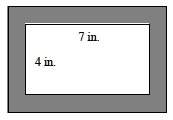
- If the frame is one tile wide, how many 1-inch-square tiles will she need?
- Would more 1-inch square tiles fit inside the frame or on the frame? Show how you know.
- 4-49. Four friends worked together to wash all of the cars that the Kumar family owns. They received $43.00 for doing the work and agreed to divide the earnings evenly. How much money will each friend earn? Show how you know. Homework Help ✎
- 4-50. Copy and complete the generic rectangle below. What multiplication problem does it represent and what is the product? Homework Help ✎
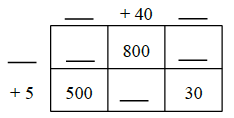
- 4-51. Use the portions representation web to rewrite each percent as a fraction, as a decimal and with words or a picture. Homework Help ✎
- 13%
- 20%
- 130%
- 32%
Due:
Assignment
Adding and Subtracting Mixed Numbers
- To add or subtract mixed numbers, you can either add or subtract their parts, or you can change the mixed numbers into fractions greater than one.
- To add or subtract mixed numbers by adding or subtracting their parts, add or subtract the whole-number parts and the fraction parts separately. Adjust if the fraction in the answer would be greater than one or less than zero. For example, the sum of
 is calculated below.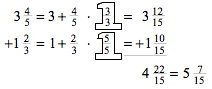
- It is also possible to add or subtract mixed numbers by first changing them into fractions greater than one. Then add or subtract in the same way you would if they were fractions between 0 and 1. For example, the sum of
 is calculated below.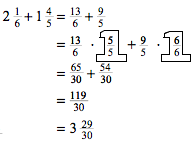
Notes of interest:
VARIABLE
The word “variable” represents two different ideas depending on the context. If we want to solve the equation 2x + 3 = 9, the letter x stands for an unknown, but specific, number. It cannot vary; it stands for a particular number. The problems with Croakie the Frog exemplify this kind of variable. In Chapter 7, students use variables to represent specific unknown quantities in word problems.
On the other hand, if we write 2(x + 3) = 2x + 6 (or y = 2x + 3), then x can stand for any number. For the tiles and frames in this section, x is part of an expression where x can represent any number. The variable represents a set, or collection, of numbers. The algebra tiles in Chapter 6 also exemplify this kind of variable.
In older algebra books (e.g., copyrighted in the 1930’s), a distinction was made between “unknown” and “variable.” Today, algebra books have conflated the ideas under the one term. This may be to make the transition to function easier, but it considerably confuses the definition.
For the strict definition of a variable, we do not include the notion of change. We say that a variable is a letter or other symbol that represents a number. The fact that the symbol can take on multiple values does not mean that it must change. The symbol is simply a placeholder for one or more (maybe infinitely many) numbers.
EVALUATING
We say someone evaluates an expression when they find the value of an expression for a given value of a variable. For example, if we evaluate the expression 3 + 2(x + y) − 5x when x = 2 and y = 7, we would get 3 + 2(2 + 7) − 5 · 2 = 11. On the other hand, we solve an equation when we find all values of a variable so that both sides of the equation are equal. For example, the equation 3x − 7 = 20 is solved by x = 9 since 3(9) − 7 = 20. Here, x = 9 is the only value that solves the equation.Due:
Assignment
Adding and Subtracting Mixed Numbers
- To add or subtract mixed numbers, you can either add or subtract their parts, or you can change the mixed numbers into fractions greater than one.
- To add or subtract mixed numbers by adding or subtracting their parts, add or subtract the whole-number parts and the fraction parts separately. Adjust if the fraction in the answer would be greater than one or less than zero. For example, the sum of is calculated below.
- It is also possible to add or subtract mixed numbers by first changing them into fractions greater than one. Then add or subtract in the same way you would if they were fractions between 0 and 1. For example, the sum of is calculated below.
Notes of interest:
VARIABLE
The word “variable” represents two different ideas depending on the context. If we want to solve the equation 2x + 3 = 9, the letter x stands for an unknown, but specific, number. It cannot vary; it stands for a particular number. The problems with Croakie the Frog exemplify this kind of variable. In Chapter 7, students use variables to represent specific unknown quantities in word problems.
On the other hand, if we write 2(x + 3) = 2x + 6 (or y = 2x + 3), then x can stand for any number. For the tiles and frames in this section, x is part of an expression where x can represent any number. The variable represents a set, or collection, of numbers. The algebra tiles in Chapter 6 also exemplify this kind of variable.
In older algebra books (e.g., copyrighted in the 1930’s), a distinction was made between “unknown” and “variable.” Today, algebra books have conflated the ideas under the one term. This may be to make the transition to function easier, but it considerably confuses the definition.
For the strict definition of a variable, we do not include the notion of change. We say that a variable is a letter or other symbol that represents a number. The fact that the symbol can take on multiple values does not mean that it must change. The symbol is simply a placeholder for one or more (maybe infinitely many) numbers.
EVALUATING
We say someone evaluates an expression when they find the value of an expression for a given value of a variable. For example, if we evaluate the expression 3 + 2(x + y) − 5x when x = 2 and y = 7, we would get 3 + 2(2 + 7) − 5 · 2 = 11. On the other hand, we solve an equation when we find all values of a variable so that both sides of the equation are equal. For example, the equation 3x − 7 = 20 is solved by x = 9 since 3(9) − 7 = 20. Here, x = 9 is the only value that solves the equation.Due:
Assignment
Adding and Subtracting Mixed Numbers
- To add or subtract mixed numbers, you can either add or subtract their parts, or you can change the mixed numbers into fractions greater than one.
- To add or subtract mixed numbers by adding or subtracting their parts, add or subtract the whole-number parts and the fraction parts separately. Adjust if the fraction in the answer would be greater than one or less than zero. For example, the sum of is calculated below.
- It is also possible to add or subtract mixed numbers by first changing them into fractions greater than one. Then add or subtract in the same way you would if they were fractions between 0 and 1. For example, the sum of is calculated below.
Notes of interest:
VARIABLE
The word “variable” represents two different ideas depending on the context. If we want to solve the equation 2x + 3 = 9, the letter x stands for an unknown, but specific, number. It cannot vary; it stands for a particular number. The problems with Croakie the Frog exemplify this kind of variable. In Chapter 7, students use variables to represent specific unknown quantities in word problems.
On the other hand, if we write 2(x + 3) = 2x + 6 (or y = 2x + 3), then x can stand for any number. For the tiles and frames in this section, x is part of an expression where x can represent any number. The variable represents a set, or collection, of numbers. The algebra tiles in Chapter 6 also exemplify this kind of variable.
In older algebra books (e.g., copyrighted in the 1930’s), a distinction was made between “unknown” and “variable.” Today, algebra books have conflated the ideas under the one term. This may be to make the transition to function easier, but it considerably confuses the definition.
For the strict definition of a variable, we do not include the notion of change. We say that a variable is a letter or other symbol that represents a number. The fact that the symbol can take on multiple values does not mean that it must change. The symbol is simply a placeholder for one or more (maybe infinitely many) numbers.
EVALUATING
We say someone evaluates an expression when they find the value of an expression for a given value of a variable. For example, if we evaluate the expression 3 + 2(x + y) − 5x when x = 2 and y = 7, we would get 3 + 2(2 + 7) − 5 · 2 = 11. On the other hand, we solve an equation when we find all values of a variable so that both sides of the equation are equal. For example, the equation 3x − 7 = 20 is solved by x = 9 since 3(9) − 7 = 20. Here, x = 9 is the only value that solves the equation.Due:
Assignment
 Video Link: Adding and Subtracting Mixed Numbers #1
Adding and Subtracting Mixed Numbers
- To add or subtract mixed numbers, you can either add or subtract their parts, or you can change the mixed numbers into fractions greater than one.
- To add or subtract mixed numbers by adding or subtracting their parts, add or subtract the whole-number parts and the fraction parts separately. Adjust if the fraction in the answer would be greater than one or less than zero. For example, the sum of is calculated below.
- It is also possible to add or subtract mixed numbers by first changing them into fractions greater than one. Then add or subtract in the same way you would if they were fractions between 0 and 1. For example, the sum of is calculated below.
Due:
Assignment
- Mixed Numbers and Fractions Greater than One
- The number
 is called a mixed number because it is composed of a whole number, 3, and a fraction,
  .
. - The number
 is called a fraction greater than one because the numerator, which represents the number of equal pieces, is larger than the denominator, which represents the number of pieces in one whole, so its value is greater than one. (Sometimes such fractions are called “improper fractions,” but this is just a historical term. There is nothing actually wrong with the fractions.)
  As you can see in the diagram at right, the fraction can be rewritten as
 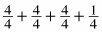 , which shows that it is equal in value to
  .
.- Your choice: Depending on which arithmetic operations you need to perform, you will choose whether to write your number as a mixed number or as a fraction greater than one.
Notes of interest:
VARIABLE
The word “variable” represents two different ideas depending on the context. If we want to solve the equation 2x + 3 = 9, the letter x stands for an unknown, but specific, number. It cannot vary; it stands for a particular number. The problems with Croakie the Frog exemplify this kind of variable. In Chapter 7, students use variables to represent specific unknown quantities in word problems.
On the other hand, if we write 2(x + 3) = 2x + 6 (or y = 2x + 3), then x can stand for any number. For the tiles and frames in this section, x is part of an expression where x can represent any number. The variable represents a set, or collection, of numbers. The algebra tiles in Chapter 6 also exemplify this kind of variable.
In older algebra books (e.g., copyrighted in the 1930’s), a distinction was made between “unknown” and “variable.” Today, algebra books have conflated the ideas under the one term. This may be to make the transition to function easier, but it considerably confuses the definition.
For the strict definition of a variable, we do not include the notion of change. We say that a variable is a letter or other symbol that represents a number. The fact that the symbol can take on multiple values does not mean that it must change. The symbol is simply a placeholder for one or more (maybe infinitely many) numbers.
EVALUATING
We say someone evaluates an expression when they find the value of an expression for a given value of a variable. For example, if we evaluate the expression 3 + 2(x + y) − 5x when x = 2 and y = 7, we would get 3 + 2(2 + 7) − 5 · 2 = 11. On the other hand, we solve an equation when we find all values of a variable so that both sides of the equation are equal. For example, the equation 3x − 7 = 20 is solved by x = 9 since 3(9) − 7 = 20. Here, x = 9 is the only value that solves the equation.Due:
Assignment
Due:
Assignment
Due:
Assignment
Tuesday, December 15th, 2015
Due:
Assignment
Monday, December 14th, 2015
Due:
Assignment
Friday, December 11th, 2015
- To formalize the concept of absolute value
- (How Far)
-
CW: * How Far? & Monthly Electricity Use
Using a thermometer (*Thermometer handout)
- Pre-discussion on Celcius and Fahrenheit
- Water freezes at 0 degrees C and 32 degrees F
- Water boils at 100 degrees C and 212 degrees F
- Two scales?
- Role of Zero?
- If the temperature was 20 degrees below zero and got warmer by 2 degrees, what would be the new temperature?
- Where is -18 in relationship to -20 on the thermometer?
- Where is -18/-20 in relationship to zero on a thermometer?
- If I were on an expedition to the North Pole and I needed to boil some snow/water (-18 degrees C), how many degrees would I need to heat the snow.
- before it melted (absolute value)
- to boil
- 6.NS.5 Understand that positive and negative numbers are used together to describe quantities having opposite directions or values (e.g., temperature above/below zero, elevation above/below sea level, credits/debits, positive/negative electric charge); use positive and negative numbers to represent quantities in real-world contexts, explaining the meaning of 0 in each situation.
- 6.NS.7.b Understand ordering and absolute value of rational numbers; b, Write, interpret and explain statements of order for rational numbers in real-world contexts.
-
6.NS. 7. Understand ordering and absolute value of rational numbers.
a. Interpret statements of inequality as statements about the relative position of two numbers on a number line diagram. For example, interpret –3 > –7 as a statement that –3 is located to the right of –7 on a number line oriented from left to right.
b. Write, interpret, and explain statements of order for rational numbers in real- world contexts. For example, write –3°C > –7°C to express the fact that –3°C is warmer than –7°C.
c. Understand the absolute value of a rational number as its distance from 0 on the number line; interpret absolute value as magnitude for a positive or negative quantity in a real-world situation. For example, for an account balance of –30 dollars, write |–30| = 30 to describe the size of the debt in dollars.
-
Student Notes:
Absolute Value

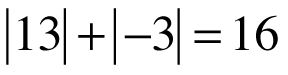
- Absolute value represents the numerical value of a number without regard to its sign. Absolute value can represent the distance on a number line between a number and zero. Since a distance is always positive, the absolute value is always either a positive value or zero. The absolute value of a number is never negative. The symbol for absolute value is two vertical bars,
 .
.
Due:

Assignment
Thursday, December 10th, 2015
- To use scale measures to make conjecture and see positive and negative numbers in real world contexts to support the concept of “opposite directions or values” , 0= (+n) + (-n)
- Interpret differing values as negative and their relationship to zero.
- Understand the role of zero in context
CW: How much did the temperature drop?
Using a thermometer (*Thermometer handout)
- Pre-discussion on Celcius and Fahrenheit
- Water freezes at 0 degrees C and 32 degrees F
- Water boils at 100 degrees C and 212 degrees F
- Two scales?
- Role of Zero?
- If the temperature was 20 degrees below zero and got warmer by 2 degrees, what would be the new temperature?
- Where is -18 in relationship to -20 on the thermometer?
- Where is -18/-20 in relationship to zero on a thermometer?
- If I were on an expedition to the North Pole and I needed to boil some snow/water (-18 degrees C), how many degrees would I need to heat the snow.
- before it melted (absolute value)
- to boil
- 6.NS.5 Understand that positive and negative numbers are used together to describe quantities having opposite directions or values (e.g., temperature above/below zero, elevation above/below sea level, credits/debits, positive/negative electric charge); use positive and negative numbers to represent quantities in real-world contexts, explaining the meaning of 0 in each situation.
- 6.NS.7.b Understand ordering and absolute value of rational numbers; b, Write, interpret and explain statements of order for rational numbers in real-world contexts.
-
6.NS. 7. Understand ordering and absolute value of rational numbers.
a. Interpret statements of inequality as statements about the relative position of two numbers on a number line diagram. For example, interpret –3 > –7 as a statement that –3 is located to the right of –7 on a number line oriented from left to right.
b. Write, interpret, and explain statements of order for rational numbers in real- world contexts. For example, write –3°C > –7°C to express the fact that –3°C is warmer than –7°C.
c. Understand the absolute value of a rational number as its distance from 0 on the number line; interpret absolute value as magnitude for a positive or negative quantity in a real-world situation. For example, for an account balance of –30 dollars, write |–30| = 30 to describe the size of the debt in dollars.
-
Student Notes:
Absolute Value
- Absolute value represents the numerical value of a number without regard to its sign. Absolute value can represent the distance on a number line between a number and zero. Since a distance is always positive, the absolute value is always either a positive value or zero. The absolute value of a number is never negative. The symbol for absolute value is two vertical bars, .
Due:
Assignment
Wednesday, December 9th, 2015
- HW Review: Please review/discuss any questions the students may have from yesterday’s assignment.
- CW: 3.2.3 How do the distances compare?
- Problems 3-111 through 3-115 in their “yellow” CPM booklets.
- Lesson Objective: Students will consider absolute value as distance from zero and understand the meaning of zero within a context. They will compare rational numbers using inequalities in contextual situations.
- Lesson Standards:
- 6.NS.7b. Write, interpret, and explain statements of order for rational numbers in real-world contexts. For example, write –3º C > –7º C to express the fact that –3º C is warmer than –7º C.
- 6.NS.7c. Understand the absolute value of a rational number as its distance from 0 on the number line; interpret absolute value as magnitude for a positive or negative quantity in a real-world situation. For example, for an account balance of –30 dollars, write |–30| = 30 to describe the size of the debt in dollars.
- 6.NS.7d. Distinguish comparisons of absolute value from statements about order. For example, recognize that an account balance less than –30 dollars represents a debt greater than 30 dollars.
- HW: 3.2.3 Review and Preview
- Problems (118 to 122)

- 3-118. Simplify the following expressions. Show your work. Homework Help ✎
- 8.23 + 10.9
- −6−9
- 8 − 3 − 4
- 0−3
- 15−20
- −9 + 14

- 5−9
- 3-119. Solve the number puzzles below. 3-119 HW eTool Homework Help ✎
- If I add 9 to my number, I get 6. What is my number?
- If I start at –5 on a number line and end up at –8, what direction did I move? How many units did I move?
- If I moved up 8 and then moved down 8, what can you tell me about my ending position?
- 3-120. You can see in the examples below that not all number lines increase by one unit from mark to mark. Sketch the number lines on your paper and fill in the missing numbers. Homework Help ✎
- 3-121. A triangular flower bed (space for planting flowers) needs a thin metal border all the way around it. The sides are 7 feet, 6 feet, and 9 feet long. Homework Help ✎
- How many feet of border should be purchased? Make a sketch and show your work.
- If borders cost $8.75 per yard (and only whole numbers of yards can be purchased), how much would the border cost?
- 3-122. One of the topics you will review in this course is reading graphs. Look at the graph below. This graph shows positive and
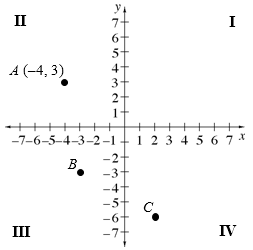 negative values on both axes. It divides the plane into four parts, or quadrants. It is called a four-quadrant graph. The quadrants are numbered I, II, III, and IV in a counter-clockwise manner as shown. Homework Help ✎
- The coordinates (the x- and y- values) for point A are (–4, 3). Explain how these numbers tell you the position of point A using the graph.
- Name the coordinates (x, y) for points B and C.
- If Deepak moved from point A 8 units to the right and 10 units down, at what point on the graph would he end up? Which quadrant is the new point in?|




Due:
Assignment
Tuesday, December 8th, 2015
Lesson 3.2.2 Where does it land?
Locating Negative Numbers
|
Lesson Objective: |
Students will position rational numbers on a number line and will make statements about their relative size using inequalities. |
- Objective(s):
6.NS.4. Find the greatest common factor of two whole numbers less than or equal to 100 and the least common multiple of two whole numbers less than or equal to 12. Use the distributive property to express asum of two whole numbers 1–100 with a common factor as a multiple of a sum of two whole numbers with no common factor. For example, express 36 + 8 as 4 (9 + 2).
- 6.NS.5. Understand that positive and negative numbers are used together to describe quantities having opposite directions or values (e.g., temperature above/below zero, elevation above/below sea level, credits/debits, positive/negative electric charge); use positive and negative numbers to represent quantities in real-world contexts, explaining the meaning of 0 in each situation.
- 6.NS.5. Understand that positive and negative numbers are used together to describe quantities having opposite directions or values (e.g., temperature above/below zero, elevation above/below sea level, credits/debits, positive/negative electric charge); use positive and negative numbers to represent quantities in real-world contexts, explaining the meaning of 0 in each situation.
- 6.NS.6c. Find and position integers and other rational numbers on a horizontal or vertical number line diagram; find and position pairs of integers and other rational numbers on a coordinate plane.
- 6.NS.7a. Interpret statements of inequality as statements about the relative position of two numbers on a number line diagram. For example, interpret –3 > –7 as a statement that –3 is located to the right of –7 on a number line oriented from left to right.
-
CW: 3.2.2 Where does it land? Problems 99 to 104
HW: Finish the CW 99 to 104
-
In the last lesson, you looked at how a frog could hop in different directions along a number line. Sometimes it could end up on the other (opposite) side of zero and other times end up in the same place after a series of hops. In this lesson, you will also develop an understanding of “greater than” or “less than” when working with negative numbers. You will also work at getting the frog to land between integers on a number line.
- 3-99. Elliot is working on his frog video game again. He has designed a new game with two frogs, each on their own number line. Each frog starts at 0, each hop is the same distance, and each hop is always to the right. The person playing the game gets to choose numbers on the number line. Points are scored for choosing a number that both frogs will land on. Frog Race
-
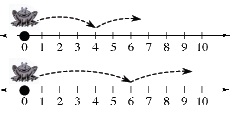
- Your Task: Determine if the frogs in the games below will ever land on the same number(s). If not, why not? If so, which number(s) will they both land on? Draw diagrams to justify your answers.
- What if Frog A hops to the right 4 units at a time and Frog B hops to the right 6 units at a time?
- What if Frog A hops 15 units
at a time and Frog B hops 9 units at a time?
- How did you use the length of the frogs’ jumps to determine your answers in part (a)? With your team, find a method for determining all of the numbers that both frogs will land on.
- The numbers in your lists from part (a) are referred to as common multiples. For example, 24 is a common multiple of 4 and 6 because 24 is a multiple of 4 and also a multiple of 6. The smallest number on your list is called the least common multiple. Find the least common multiple of 8 and 12.
- 3-100. Each expression below could represent the hops of a frog on a number line. Draw a number line on your paper and use it to find the answer. Be ready to share your strategy. You may want to explore your ideas using 3-100 Student eTool (CPM). Move the colored dots to help you keep track of your ideas.
- −2 − 9
- 5 − 5
- −(−4) + 7
- −6 + 2
- −(−1) − 8
- 3-101. Baker is a balloonist who has a balloon-tour company on the North Rim of the Grand Canyon. One day he took his balloon
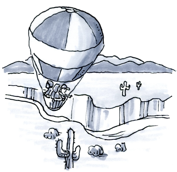 up to 1500 ft to give his guests a bird’s-eye view of the entire Canyon. Then he lowered the balloon to the bottom of the Canyon so his guests could swim in the Colorado River. The river is over a mile (5700 ft) below the North Rim. After lunch, the tourists all got back aboard the balloon. The balloon carried them up to the South Rim, 4500 ft above the river.
- Draw a diagram that shows the balloon’s elevation throughout the day.
- Label the North Rim as zero, since it is the starting place. Then find out the elevation of the balloon tourists’ stopping place (the South Rim) relative to their starting place (the North Rim).
- 3-102. In one frog-jumping contest, a frog named ME-HOP started at zero, hopped 7 feet to the right, and then hopped 4 feet to the left. Meanwhile, Mr. Toad also started at zero, hopped 8 feet to the left, and then hopped 1 foot to the right.
- Write expressions to represent these hops for each frog.
- Which frog is farther ahead (that is, more to the right on the number line)? Explain. Use an inequality to record your answer.
- 3-103. In each of the four contests below, two frogs are hopping. The two numbers given in each part show the frogs’ final landing points. In each contest, which frog is farther ahead? (This question is another way of asking which frog is at the larger number.) Write an inequality statement (using < or >) to record your answer.
- −2 or 1
- 3 or −17
- −(3) or −(−3)
- 2 or 0
- 3-104. Who was ahead in each of the following contests? Plot the landing point given for each frog on a number line, and represent your answer with an inequality.
- Froglic:
 feet
feet
Green Eyes: −2 feet
- Warty Niner: −3.85 feet
Slippery: −3.8 feet - Rosie the Ribbiter: − 4

Pretty Lady:
- Froglic:
- Your Task: Determine if the frogs in the games below will ever land on the same number(s). If not, why not? If so, which number(s) will they both land on? Draw diagrams to justify your answers.
Due:
Assignment
Monday, December 7th, 2015
Due:
Assignment
Due:
Assignment
Wednesday, December 2nd, 2015
Lesson Correction and Review
Due:
Assignment
Tuesday, December 1st, 2015
- 3-94. Lucas’ frog is sitting at −2 on the number line. 3-94 HW eTool (CPM). Homework Help ✎
- His frog hops 4 units to the right, 6 units to the left, and then 8 more units to the right. Write an expression (sum) to represent his frog’s movement.
- Where does the frog land?
- What number is the opposite of where Lucas’ frog landed?
- 3-95. Draw and label a set of axes on your graph paper. Plot and label the following points: (1,3), (4,2), (0,5), and (5,1). Homework Help ✎
- 3-96. Rewrite each product below using the Distributive Property. Homework Help ✎
Then simplify to find the answer.- 18(26)
- 6(3405)
- 21(35)
- 3-97. Compute each sum or difference. Homework Help ✎
- 3-98. A seed mixture contains ryegrass and bluegrass. If 40% of the mixture is ryegrass, what is the ratio of ryegrass to bluegrass? Homework Help ✎


Due:
Assignment
Monday, November 30th, 2015
Due:
Assignment
Tuesday, November 17th, 2015
Purpose: Students will be introduced to the concept of a ratio and use ratio language to describe a relationship between two quantities. They will use diagrams and ratio tables to represent ratios.
Standard: 6.RP.1. Understand the concept of a ratio and use ratio language to describe a ratio relationship between two quantities. For example, “The ratio of wings to beaks in the bird house at the zoo was 2:1, because for every 2 wings there was 1 beak.” “For every vote candidate A received, candidate C received nearly three votes.”
CW: #81
CW: Grandpa and a Tree House
HW: 3.1.6_Review and Preview (84-88)
Due:
Assignment
Monday, November 16th, 2015
Due:
Assignment
*** Thursday, November 12th, 2015 ***
- Warm-up: 3-72 Learning Log
- students complete the learning log on page 48 in their “yellow” CPM booklets
- CW: 3.1.5
- #'s 3-70 – 3-71 students complete questions 70 & 71 in their “yellow” CPM booklets.
- HW:3.1.5 Review and Preview Problems (3-73 to 3-77)
- Additional Homework
- Study for math quiz on:
- Percents-Decimals-Fractions
- Study for math quiz on:
Due:
Assignment
November 11th, 2015
Veterans Day
Due:

Assignment
November 10th, 2015
Due:
Assignment
November 9, 2015
Due:
Assignment
Due:
Assignment
Due:
Assignment
Purpose: Students will develop an understanding of percents as a way to express and compare portions of a whole.
Standard: 6.RP.3c. Find a percent of a quantity as a rate per 100 (e.g., 30% of a quantity means 30/100 times the quantity); solve problems involving finding the whole, given a part and the percent.
Due:
Assignment
November 2, 2015
Due:
Assignment
Friday, October 30, 2015
Lesson: CPM 3.1.3_How are the representations related? (A)Purpose: Students will develop an understanding of percents as a way to express and compare portions of a whole.
Standard: 6.RP.3c. Find a percent of a quantity as a rate per 100 (e.g., 30% of a quantity means 30/100 times the quantity); solve problems involving finding the whole, given a part and the percent.
HW: Have a great and safe Halloween
Due:
Assignment
Thursday, October 29, 2015
Lesson: CPM 3.1.3_How are the representations related? (A)Purpose: Students will develop an understanding of percents as a way to express and compare portions of a whole.
Standard: 6.RP.3c. Find a percent of a quantity as a rate per 100 (e.g., 30% of a quantity means 30/100 times the quantity); solve problems involving finding the whole, given a part and the percent.
HW: 3.1.3_Review & Preview (45 to 49)
Due:
Assignment
Wednesday, October 28, 2015
Purpose: Students will develop an understanding of percents as a way to express and compare portions of a whole.
Standard: 6.RP.3c. Find a percent of a quantity as a rate per 100 (e.g., 30% of a quantity means 30/100 times the quantity); solve problems involving finding the whole, given a part and the percent.
Due:
Assignment
Tuesday, October 27, 2015
Lesson: "Walter Takes a Test" and "Coat on Sale"
*Help/Guidance/Answers: for "Coat on Sale"
Purpose: Students will develop an understanding of percents as a way to express and compare portions of a whole.
Due:
Assignment
Monday, October 26, 2015
Lesson 3.1.2 How can I describe a portion?
Due:
Assignment
Wednesday, October 21, 2015
Lesson: 3.1.1_"Are they the same?" (B)
Due:
Assignment
Tuesday, October 20, 2015
**Please note: We introduced the use of iPads and the Nearpod app during today's lesson, so the lesson will be extended through Wednesday.
Lesson: 3.1.1_"Are they the same?" (A) *Continued
Due:
Assignment
Monday, October 19th, 2015
Lesson: 3.1.1_"Are they the same?" (A)
Due:
Assignment
Due:
Assignment
Purpose: Chapter closure provides an opportunity for students to reflect about what they have learned. See the Closure section of the eBook for more information about chapter closure.
CW: Chapter 2 Team Test (1 to 22)
HW: Study for Ch. 2 Individual Assessment. *See Ch. 2 Team Test as guide.
Due:
Assignment
Lesson: Chapter 2 Closure
Purpose: Chapter closure provides an opportunity for students to reflect about what they have learned. See the Closure section of the eBook for more information about chapter closure.
CW: Ch. 2 Closure Problems (91 to 100)
HW: Ch. 2 SUMMARIZING MY UNDERSTANDING
Due:
Assignment
Due:
Assignment
- The Distributive Property states that the multiplier of a sum or difference can be “distributed” to multiply each term. For example, to multiply 8(24), written as 8(20 + 4), you can usethe generic-rectangle model at right.
- The product is found by 8(20) + 8(4). So 8(20 + 4) = 8(20) + 8(4)
- You will work more with and formalize the Distributive Property in Chapter 7.